Universal Subtitles is a subtitling and translation tool that allows virtually any video uploaded to the Internet, in order to make them more accessible to everyone.
It is very easy to use: We can take the url of a video post for example Blip.tv, YouTube, Ustream and paste it in Universal Subtitles; immediately on a subtitle can quickly and easily. In the same way, we can translate it. Finally, we get a code that will embed the video to include with subtítolts our websites.
Moreover, it is a collaborative tool: All the surfers and the video will translate or improve their language subtitles or translations that are already made.
It is a free tool and open source.
As an example, here is the video that explains how the Universal Subtitles. You can put subtitles in Catalan.
http://universalsubtitles.org/videos/MNx9rvIyWiEw/
Source: PuntTIC.cat
_________________________________
Web Portal FUNCTIONAL DIVERSITY
http://www.diversitatfuncional.org/
Blog THE ICT AND THE DISABILITY
http://discapacitat-en.diversitatfuncional.org/
Tool to easily subtitled videos Internet
Thursday, November 11, 2010
Brain Controlled Wheelchair
Monday, September 20, 2010
A team of researchers led by Professor José del R. Millán at the Swiss Federal Institute of Technology (EPFL), Lausanne, Switzerland has developed a wheelchair that can be controlled via a Brain-Computer Interface. The focus of their research is on the direct use of human brain signals to control devices and interact with the environment. They are involved in a large set of complementary projects, which balance the development of prototypes —where robust real-time operation is critical— and the exploration of new principles.
Here we see a subject testing out navigating the environment in a wheelchair by thought alone. The subject thinks of either moving their right or left arm to generate left or right movement. What is interesting is that in order to perform a particular task one doesn't have to think about that task, instead they can think about whatever is associated with that task. Essentially the computer can be trained to interpret whatever thought a subject wants to correlate with a desired outcome. Nifty!
The world's first ever Immersive Technology Summit will be held at the Los Angeles Center Studios (LACS) on October 21st, 2010.
This video is copyrighted by Ecole Polytechnique Federale de Lausanne: cnbi.epfl.ch
For more news and videos on immersive technologies visit : www.immersivetech.org
Follow us on Twitter: @immersivetechla
Follow us in Facebook
_________________________________
Web Portal FUNCTIONAL DIVERSITY
http://www.diversitatfuncional.org/
Blog THE ICT AND THE DISABILITY
http://discapacitat-en.diversitatfuncional.org/
Head Tracking for Desktop VR Displays using the Wii Remote
Saturday, September 11, 2010Johnny Chung Lee is a researcher HCI PhD in Carnegie Mellon University who works in projects linke wii remote, $14 stabilizer, giant paint balloon slingshot, projector calibration, brain-computer interaction, kinetic typography, electric cello,...
Johnny Chung Lee has published on internet this insteressant work: Head Tracking for Desktop VR Displays using the Wii Remote
Using the infrared camera in the Wii remote and a head mounted sensor bar (two IR LEDs), you can accurately track the location of your head and render view dependent images on the screen. This effectively transforms your display into a portal to a virtual environment. The display properly reacts to head and body movement as if it were a real window creating a realistic illusion of depth and space.
The program only needs to know your display size and the size of your sensor bar. The software is a custom C# DirectX program and is primarily provided as sample code for developers without support or additional documentation. You may need the most recent version of DirectX installed for this to work.
Software
To run the DesktopVR program you see in the video:
1. Connect your wiimote to your PC via Bluetooth. If you don't know how to do this, you can follow this tutorial. I've been told it works with other Bluetooth drivers, but I have not tested them myself.
2. Download the WiiDesktopVR (v02) sample program. Read the README file on program usage and configuration. Launch the "WiiDesktopVR.exe" in the main folder. A potentially more stable/Vista/64-bit compatible version has been created by Andrea Leganza. There also may be more variants on the web.
NOTE: If you are having trouble with running the program, you can check my project blog post about it or check the forum for assistance. I am unable to replicate these problems, so it hard for me to debug them. But, other people have figured it out. Things that have been identified to help: delete the "config.dat" file and re-run the program, install a new version of Direct X, or istall .NET 2.0.
Developers Notes: The code is built on top of this Wiimote library. To compile the program, you will need a C# IDE and the DirectX SDK. More notes are in the README.
A visit to this project's FAQ and Advanced Discussion post may be very englightening. You may also find the official discussion forums for my wiimote projects helpful: WiimoteProject.com
Source: Johnny Chung Lee http://johnnylee.net/ Projects WII http://johnnylee.net/projects/wii/
Follow us in Facebook
_________________________________
Web Portal FUNCTIONAL DIVERSITY
http://www.diversitatfuncional.org/
Blog THE ICT AND THE DISABILITY
http://discapacitat-en.diversitatfuncional.org/
Low-Cost Multi-point Interactive Whiteboards Using the Wiimote by Johnny Chung Lee
Johnny Chung Lee is a researcher HCI PhD in Carnegie Mellon University who works in projects linke wii remote, $14 stabilizer, giant paint balloon slingshot, projector calibration, brain-computer interaction, kinetic typography, electric cello,...
Johnny Chung Lee has published on internet this insteressant work: Low-Cost Multi-point Interactive Whiteboards Using the Wiimote
Since the Wiimote can track sources of infrared (IR) light, you can track pens that have an IR led in the tip. By pointing a wiimote at a projection screen or LCD display, you can create very low-cost interactive whiteboards or tablet displays. Since the Wiimote can track upto 4 points, up to 4 pens can be used. It also works great with rear-projected displays.
Software
The calibration and mouse cursor emulation software is available for you to download and try yourself. Note: My mouse emulation code isn't perfect. If any of you are programmers and can get it working with Alias Sketchbook, drop me a line.
1. Connect your wiimote to your PC via Bluetooth. There are a number of tutorials online on how to do this, possibly even for you specific software/hardware configuration. The Wiimote works with many (but not all) Bluetooth drivers. You can report/read about compatibility issues at WiimoteProject.com
2. Download the Wiimote Whiteboard software to the right. Please read the "READ ME.txt" file first! Make sure your wiimote is connected via Bluetooth, and then run the ".exe" in the main folder. NOTE: Good placement of the wiimote is key to good tracking. View the README for more info.
Multitouch: The multitouch demos are custom C# DirectX programs. You may download the sample program to the right, but this is provided for developers without support or documentation. The code is built on top of this Wiimote library. Unfortunately, multi-touch capable applications are currently extremely rare. Hopefully, that will change as more developers explore its potential.
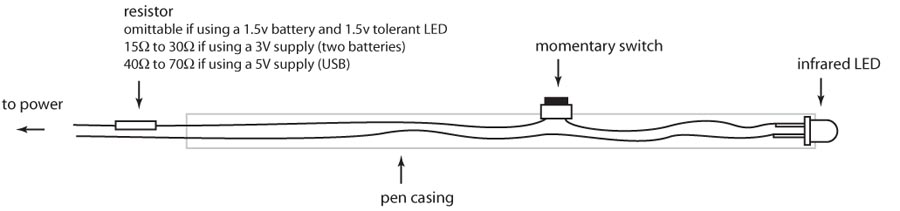
Building pens: Here is a simple schematic of the light pen. The LEDs that I use are Vishay TSAL6400s running at 100mA, but lots of other LEDs will work too. You also might be able to jump start your experimentation by retro-fitting a mini keychain light with an IR LED. I'm currently looking into manufacturing and selling IR pens, but this may take several months.
Mac/Linux Versions: Due to personal time contraints, I probably won't be able to make a port myself. But fairly mature versions are available online. However, I haven't tried them myself. I've also created a Source Forge Project - Wiimote Whiteboard, but it does not seem to be getting much love.
A visit to this project's FAQ and Advanced Discussion post may be very englightening. You may also find the official discussion forums for my wiimote projects helpful: WiimoteProject.com
Downloads:
Windows (32-bit)
Wiimote Whiteboard* (original 12/19/07) - includes source
Wiimote Whiteboard v0.2* (updated 3/27/08) - includes source
Wiimote Whiteboard v0.3* (updated 8/20/08) - includes source
* there appear to be some issues with 64-bit machines, and BlueSoleil. Alternative Bluetooth software may work. Check the forum for more info.
Mac (Java)
You can do a quick webserach or try the version created by uweschmidt which is a fairly mature Java-based version for Mac.
Multitouch:source code
Fun software (mostly free) to try with this:
Mapping software: Microsoft Virtual Earth, Google Earth
Physics simulation software: Phun
Virtual Tourism: Photosynth
Media Browsing: CoolIris
Painting progams: Alias Sketchbook Pro
Note taking:One Note
Handwritting recognition: Windows Tablet PC Edition - works great if you have it, not a stand alone program to install.
Source: Johnny Chung Lee http://johnnylee.net/ Projects WII http://johnnylee.net/projects/wii/
Follow us in Facebook
_________________________________
Web Portal FUNCTIONAL DIVERSITY
http://www.diversitatfuncional.org/
Blog THE ICT AND THE DISABILITY
http://discapacitat-en.diversitatfuncional.org/
Tracking Your Fingers with the Wiimote
Johnny Chung Lee is a researcher HCI PhD in Carnegie Mellon University who works in projects linke wii remote, $14 stabilizer, giant paint balloon slingshot, projector calibration, brain-computer interaction, kinetic typography, electric cello,...
Johnny Chung Lee has published on internet this insteressant work: Tracking Your Fingers with the Wiimote
Using an LED array and some reflective tape, you can use the infrared camera in the Wii remote to track objects, like your fingers, in 2D space. This lets you interact with your computer simply by waving your hands in the air similar to the interaction seen in the movie "Minority Report". The Wiimote can track upto 4 points simultaneously. The multipoint grid software is a custom C# DirectX program.
Software
To run the grid program you see in the video:
1. First, follow this walkthrough on using the wiimote with C#. You may need to download a copy of Visual C# Express to compile/run this sample if you don't have it yet.
2. Download a copy of the DirectX SDK. You may not need this to simply run the sample grid program, but you will need it if you want to make any changes to it.
3. Download the Wiimote Multipoint Grid sample program. Make sure your wiimote is connected via bluetooth, and then run the ".exe" shortcut in the main folder.
A visit to this project's FAQ and Advanced Discussion post may be very englightening. You may also find the official discussion forums for my wiimote projects helpful: WiimoteProject.com
Source: Johnny Chung Lee http://johnnylee.net/ Projects WII http://johnnylee.net/projects/wii/
Follow us in Facebook
_________________________________
Web Portal FUNCTIONAL DIVERSITY
http://www.diversitatfuncional.org/
Blog THE ICT AND THE DISABILITY
http://discapacitat-en.diversitatfuncional.org/
Project Fressa 2010: free software for educational awareness
Tuesday, September 7, 2010Jordi Lagares published on the Internet on your page an excellent collection of educational resources and software for people with disabilities.
http://www.xtec.cat/~jlagares/
Within the page are especially a section oriented to project Fressa 2010 with lots of free software.
The project Fressa 2010. Software for special education
http://www.xtec.cat/~jlagares/eduespe.htm(Catalan)
http://www.xtec.cat/jlagares~/f2kesp.htm (spanish)
Software
For people with disabilities motòrica controlled scanning and / or rat and / or switches (push)
Program: Plaphoons. Dynamic communicator.
Program: Monitoring of the Rat.
Program: Kanghooru. To perform any automated scanning program.
Program: Keyboard Magic. Verbal communicator. Writing system.
Program: Game flying saucers.
Program: Control games. With such games.
Program: Monitoring of a keyboard. Writing system.
Program: Spend pages to read books or be read.
Program: Mouse Joystick to control the mouse using a joystick.
Program: Screen Scanner to scan the mouse on the screen.
Program: Keyboard Mouse Converter converts clicks of keystrokes in the rat.
Program: Converter mouse or keyboard in stereo microphone allows for a single or double switch from various gadgets attached to the stereo audio input, such as headphones.
For people with disabilities and motòrica whoever.
Program: Reading texts.
Program: Read.
For people with disabilities and controlled by voice motòrica
Program: Monitoring of the Rat.
For people with visual disabilities and / or motor
Program: The humbug.
Program: Web Browser speak and contolat to scan.
Program: Text to MP3.
For people with visual disabilities
Program: Reading books for blind people.
For people with hearing impairment
Program Globe 3. Exercises with games lasting intensity.
Program: Recognition of phonemes. Exercises with games of discrimination.
Program: Recognition of vowels.
For developers who want to develop programs controlled by phonemes
SDK: recognition engine sounds, DLL, sample software and how to use it.
Follow us in Facebook
_________________________________
Web Portal FUNCTIONAL DIVERSITY
http://www.diversitatfuncional.org/
Blog THE ICT AND THE DISABILITY
http://discapacitat-en.diversitatfuncional.org/
Inclusive Web Design
Monday, September 6, 2010The "Encuentro Latinoamericano de Diseño 2010", which is held every year at the University of Palermo in Buenos Aires, is an open, free and open where design professionals in all its expressions are presented as desiteresada to present their experiences and new trends in the area of their disciplines. They go to these places a large audience mostly university students throughout Latin America.
This year, among many shares are presented for the first time in this event the thematic Web Accessibility and its relation to the design and communication.
Source: Desarrollos DG
http://www.desarrollosdg.com.ar/educativos/expresion/ampliar_noticia1.php?art=124
Follow us in Facebook
_________________________________
Web Portal FUNCTIONAL DIVERSITY
http://www.diversitatfuncional.org/
Blog THE ICT AND THE DISABILITY
http://discapacitat-en.diversitatfuncional.org/
Deaf Students Test Sign Language on Smartphones
Sunday, September 5, 2010

Photos:Mary Levin/University of Washington
Source: Wired http://www.wired.com/gadgetlab/2010/08/deaf-students-sign-language/
Follow us in Facebook
_________________________________
Web Portal FUNCTIONAL DIVERSITY
http://www.diversitatfuncional.org/
Blog THE ICT AND THE DISABILITY
http://discapacitat-en.diversitatfuncional.org/
Digital Whiteboard low cost awarded by the CEEI in Spain
Saturday, September 4, 2010The BIC awards to two students of the IES Batoy to create a low-cost whiteboard
The European Business and Innovation Centre (CEEI) Alcoy presented the 'Award Monkey', convened to encourage and promote entrepreneurship among students, teachers and schools in Valencia (Spain), Jose Antonio Orejuela and Antonio Vivas, Alcoy Center of Batoy, the degree of innovation and bring your project feasibility. It's about creating a digital whiteboard low cost through the use of free software.
This idea of creating a digital whiteboard, low cost project emerged in 2009 as the end of the first course in the Vocational Training Course Operational Information Systems. In the words of the promoters, "due to the high demand expected whiteboards in the world of education, we thought it would be interesting exploitation of this field, with a more affordable product than conventional tactile tiles." "This is a commitment to integrating new technologies as a tool for education in the classroom. Unlike the conventional whiteboards, use a free software that lets you create a similar product but at a much lower price, thanks it could incorporate the training of service users. "
The prize is 400 euros in cash and the installation option without charge for six months at the BIC, where up the company.
The second edition of the "Monkey Awards' will open in late April and the regulations will be published on the web http://www.ceei-alcoy.com/
Source:
Fuente:CEEI Alcoy http://www.ceei-alcoy.com/index.php?op=8&n=1969&nl=1
_______________________________
FUNCTIONAL DIVERSITY Web Portal
http://www.diversitatfuncional.org/
Blog THE ICT AND THE DISABILITY
http://discapacitat-en.blogspot.com/
Grown in the lab: Artificial implants that restore sight in partially blind patients
Sunday, August 29, 2010
Button-shaped artificial corneas have restored the sight in men and women in danger of going blind.
The man-made corneas were just as good at improving eyesight as those usually obtained from donors.
In time, the transparent implants could help ease the dire shortage of donated corneas.
Around 3,000 transplants are carried out in the UK each year but hundreds more could have benefited from the surgery.
In focus: Dr May Griffith of the research team inspects a biosynthetic cornea that can be implanted into the eye to repair damage and restore sight
Worldwide, 1.5million people go blind each year because they cannot have corneal transplants.
Damage to the cornea, the collagen-based transparent outermost layer of the eye, is one of the most common causes of blindness. It affects ten million people around the world and can be caused by genetics, surgery, burns, infection or chemotherapy.
Previous attempts to develop synthetic implants have had limited success. To create an implant that is as close as the real thing as possible, the North American and Swedish researchers grew a synthetic form of human collagen in the lab and moulded it into wafer-thin button-like shapes.
Ten men and women with corneal disease had the damaged tissue scraped away from the surface of the eye and replaced with a man-made cornea in a half-hour operation.
Over time, the patients were able to blink and cry and the nerves severed by the surgery mended.
Fitted with contact lenses, the patients were able to see as well as people who had conventional corneal transplants, the journal Science Translational Medicine reports. Two years after the op, the lab- grown corneas were still working well.
Using ' biosynthetic' corneas removes the risks of disease and rejection associated with corneas taken from donors after death.
Dr May Griffith, of the University of Ottawa in Canada and Linkoping University in southern Sweden, said: 'This study is important because it is the first to show that an artificially fabricated cornea can integrate within the human eye and stimulate regeneration.
' With further research, this approach could help restore sight to millions of people who are waiting for a donated cornea for transplantation.
Implantation of a biosynthetic cornea in a patient with advanced keratoconus
Workers produce artificial crystalline lens and eye cornea at the factory of the Eye Microsurgery Complex
The journal reported: ' The see-through nature of the cornea is easily destroyed by trauma or infection but replacement human corneas can be inserted and reliably restore vision.
'The problem is that the shortage of donated corneas leaves millions of people likely to go blind. An alternative source of corneas could make a big difference.
'These biosynthetic corneas may soon allow patients who need transplants but do not have donors to regain normal sight.'
Barbara McLaughlan, of the Royal National Institute of Blind People, said: 'This is potentially an exciting new development for patients with corneal blindness where currently transplant from a human donor is the only treatment opt ion available.
'The first results of this small scale trial in humans seem very encouraging, however mor e research is needed to determine if this could work for all types of corneal blindness and become a widely available treatment.
'RNIB is committed to reducing the number of people who lose their sight unnecessarily, and will follow developments in the hope that the potential of biosynthetic corneas to save sight can be realised.'
Source: Mail Online
http://www.dailymail.co.uk/health/article-1306134/Artificial-corneas-restore-sight-partially-blind-patients-grown-lab.html#
_______________________________
FUNCTIONAL DIVERSITY Web Portal
http://www.diversitatfuncional.org/
Blog THE ICT AND THE DISABILITY
http://discapacitat-en.blogspot.com/
The virtual rehabilitation, the future of "specialty unit"
Tuesday, June 22, 2010 This was stated today the president of the Society of the Spanish Society of Physical and Rehabilitation Medicine (SERMEF), Inmaculada García, in a press conference following the opening of its 48th national congress, where he noted that virtual rehabilitation "is the present future .
It consists, he said, the use of new graphics technologies, interactive and telecommunications to provide rehabilitation services and tele-rehabilitation more effectively and efficiently.
These new applications allow you to save in times of crisis and the rehabilitation physician has the capacity to treat more people, he said.
Garcia stressed that you can rehabilitate a large number of people through software, even from a distance, avoiding movements, displacement and loss of working hours.
This area combines multidisplicinar technological fields such as virtual reality, medical imaging, bio-electronics, intelligence, environmental or natural interface between man and machine for better therapies for patients and they are also more sustainable for health services.
He stressed that these developments are important in a specialty that deals with life-long address chronic diseases such as musculoskeletal pain, which are the most prevalent, or patients with severe disability, such as quadriplegics or those who suffer brain damage therefore considered that this area could revolutionize the virtual completion neuro-rehabilitation in the coming years.
Source: Notícias EFE
_______________________________
FUNCTIONAL DIVERSITY Web Portal
http://www.diversitatfuncional.org/
Blog THE ICT AND THE DISABILITY
http://discapacitat-en.diversitatfuncional.org/
PDF manuals for the care of students with special needs educational support
Monday, June 21, 2010Through the list of RedIris © Paidos correu-SEN Special Educational Needs we have received a great news that we reproduce on the blog.
The Education of the board of Andalusia (Spain) has published a set of 10 guidelines carried out by teachers and professionals, in collaboration with industry associations (including Autism Andalusia).
The Ministry of Education distributed in all secondary schools in the community a collection of manuals for the care of students with special needs educational support.
The objective of this initiative is to disseminate the educational community and updated basic information of students who require support for their education standard, in order from the centers provide adequate educational response to their needs.
The publication consists of a total of 10 manuals which define the general characteristics of these students, systems and procedures for identification and most appropriate educational services according to their needs.
In these guidelines addresses a broad spectrum of educational needs related to the abilities of students, such as mobility limitations, learning disorders and behavioral syndrome, hearing impairments, visual or intellectual giftedness rare diseases (high capacity intellectual).
The manuals have been published since the revision of the Guidelines for Care Students with Special Educational Needs, published by the Ministry of Education in 2007, with a view to updating and adapting the new regulatory framework in force after the approval of the Act Education in Spain.
In it, he has worked a team of over 70 teachers and professionals who have incorporated the contributions made by affected groups and community movements that promote the care and protection.
The purpose of the manual is to provide a first approach of the entire education community to the specific needs of educational support and intervention to provide guidelines and strategies, aimed at both professionals and families who are in contact with these students.
Thus, the student is seen from a global perspective as an individual, meeting their personal needs, social and family from the perspective of an inclusive school.
All manuals have the same content structure: characteristics of the students, identification and evaluation of it, have special educational needs, educational services, delineation of guidelines and most appropriate teaching strategies, guidelines and glossary for the family.
The collection also includes a CD-Rom compilation and four tokens for each Manual containing information on legislation, bibliography, reference websites and useful addresses. A total of 7,000 copies have been published, which in addition to schools will also be distributed to associations and entities that have collaborated in its preparation.
The Manual is dedicated to the TEA the number 5 and the complete collection can be downloaded in compressed file in the download area of Autism Andalusia
1. Manual services, benefits and educational resources for students with specific educational support needs.
2. Manual of attention to students with special needs educational support to present high intellectual capacities.
3. Manual care to students with specific educational support needs arising from limitations in mobility.
4. Manual of attention to students with special needs education support resulting from conduct of serious disorders.
5. Manual of attention to students with specific educational support needs arising from pervasive developmental disorders.
6. Manual of attention to students with specific educational support needs arising from Down Syndrome.
7. Manual of attention to students with specific educational support needs arising from hearing impairment.
8. Manual of attention to students with specific educational support needs arising from visual impairment and deafblindness.
9. Manual of attention to students with special needs educational support for rare diseases and suffer from chronic
10. Manual of attention to students with specific educational support needs arising from intellectual disabilities.
You can download all manuals from http://www.autismoandalucia.org/index.php?option=com_remository&Itemid=100&func=fileinfo&id=26
Source:
© Paidos-SEN Special Educational Needs
Autism Federation
Andalusia
C / Brig 2, 41012. Seville
Tel: 954241565
--------------------
Francisco Javier Soto Perez.
Technical Advisory Teacher ICT area and Diversity.
Ministry of Education, Training and Employment.
General Directorate of Promotion, Management and Educational Innovation.
Directorate General of Educational Innovation and Attention to Diversity.
Service to Diversity.
Gran Vía, 32 - Escape 2 nd, 5 th. 30 005 Murcia (Spain)
Tel: (+34) 968 365 327 - Fax.: (+34) 968 366 562
_______________________________
FUNCTIONAL DIVERSITY Web Portal
http://www.diversitatfuncional.org/
Blog ICT AND DISABILITY
http://discapacitat-en.diversitatfuncional.org/
A new technology allows you to control games with your eyes
Thursday, May 27, 2010A team of students from Imperial College London has developed a novel system that can play a traditional game using only the eyes. The feat was made possible thanks to the combination of a webcam that records eye movements and a computer program. The main advantage of this system is its price: for its manufacture are needed only 30 euros. Therefore, its creators hope the technology will serve to applications and more sophisticated games, and allow people with mobility problems have more entertainment options. By Yaiza Martínez.

The technology used for the development of this game will allow people with serious physical disabilities, like paralysis, become players of video games for the first time, Imperial College London published a statement , among other potential applications.
The students adapted a game originally released in 1972 and called Pong , which involves one or two players control the ball movement on the screen, moving the pallets vertically on both sides of this, as in a game of tennis ping pong table.
To do so, the player must put special glasses containing an infrared light and a web camera that records the movement of one eye.
The camera is connected to a laptop, which in turn has a computer program that synchronizes the movements of the eye with the game.
For now, the prototype of the game is very simple, but the students believe that technology has made it possible could be adapted to control other games and more sophisticated applications, using just eye movements.
Online cheap and available technology
One of the main benefits of this new technology is that it is cheap: using accessories as currently marketed, the system can be manufactured for less than 30 euros.
Other systems used by scientists to study the movement of the eyes and brain are around 30,000 euros, say the researchers.
Aldo Faisal , supervisor of the student team that created the prototype (belonging to the departments of computer science and bioengineering at Imperial College Lodon) that the prototype was created using items that can be purchased at a store, like a webcam.
Since one does not require expensive equipment, the technology has huge potential, says Faisal.
Scientists will allow this technology is available online, for anyone interested in creating new applications and games, and are optimistic they can encontrársele profits.
More complex tasks
In particular, the creators of this version of Pong want the system to provide entertainment options for people with limited mobility.
In the future, they say, people can turn the pages of electronic books only by blinking or blow their favorite song with just an eye movement.
Scientists are excited about the idea that their technology will serve so that others can develop new games and applications, but also continuing to work to redefine the system so that it can record the movements of both eyes, not one.
If they succeed, they may conduct more complex tasks with their eyes only, as direct a motorized wheelchair, for example.
ÉThis is not the first example we know of games that can be controlled remotely without touching a keyboard or other control device.
In 2008, for example, we talked about the emergence of the first device that controlled only with the mind games , by recording the player's brain waves, and the ability to relate these to order specific actions in the screen using a software .
Created by the company Emotiv Systems, the first device consisted of a helmet full of sensors for the recording of brain waves through a wireless connection, were later sent in the form of instructions to a computer program.
On the other hand, we have also spoken Tendencias21 of a new system, called iPoint Presenter , allowing control over the computer only with hand gestures, in the style of what we saw in the futuristic movie "Minority Report" and the Vocal Joystick which made simple vowel sounds into cursor movements on screen.
All of these devices pose significant progress towards the transformation of our relations with computers, experts say. Some of them also pursued a clear objective: to revolutionize the entertainment industry, especially video games.
Source: Hoy tecnología
_______________________________
FUNCTIONAL DIVERSITY Web Portal
http://www.diversitatfuncional.org/
Blog ICT AND DISABILITY
http://discapacitat-en.diversitatfuncional.org/
Father of autistic child creates innovative communication technology
Tuesday, May 25, 2010 The father of a child with severe autism has developed a technology that facilitates communication with the child.
Briton Stephen Lodge, creator of the system, said to have had several years ago the idea of Speak4me, but that should wait until the technology exists to carry it out. His 11 year old son, Callum, unable to speak and now uses his father's invention to communicate.
Speak4me was presented in Naidex 2010, annual fair for disabled organized by NEC in Birmingham, United Unido.Speak4me works by moving the images from one place to another and dropping them on a touch screen, thus forming sentences.
The user then press the voice button to "verbalize" the phrase.
Speak4me Callum has been using for some time and has already achieved some very expressive phrases, Lodge said the BBC. Examples mentioned: "I want a glass of juice," "I quit" and "I'm tired."
Lodge, based in South Yorkshire, has 20 years of experience in technology and has developed Speak4me after deciding that the products did not meet market needs Callum. He financed his idea to hold their savings and mortgaged his house.
For now, Speaks4me is being marketed as an integrated hardware and software. However, the company is developing software that will allow you to work on Windows systems.
Lodge explained that the system has been well received by users and is surprising how easily that autistic children understand their operation. He added that takes half an hour, or less, We understand and use Speaks4Me (speaking for me).
Another area of application would be among survivors of cardiovascular events, a third of which lose the ability to speak temporarily or permanently.
Presentation (in English) Speaks4me:
Speak4me is priced at 2000 pounds.
Source: BBC
_________________________________
Portal web DIVERSITAT FUNCIONAL
http://www.diversitatfuncional.org/
Blog LAS TIC Y LA DISCAPACIDAD
http://discapacitat-es.diversitatfuncional.org/
Signed Histories: Home Video for the deaf
Monday, May 24, 2010
The same happens for the content on the Internet because they can not hear the voices that accompany the videos for children. Thinking there is an important site where the stories are accompanied by sign language.
http://www.signedstories.com/
Designed to deliver both fun and educational materials for deaf children, Signed Histories contains an incredible amount of children's stories on video, ranging from classics to original stories for children, as well as multimedia content to the taste of the pre-adolescents.
All Signed Histories videos on screen narrating a person with sign language or subtitles, although similarly include the original audio. The site is in English, and also contains useful material for parents and teachers.
Link: Signed Histories
Source: Useful Applications
http://aplicacionesutiles.com/2010/04/signed-histories-portal-de-videos-para-ninos-sordos
_________________________________
Web Portal DIVERSITAT FUNCIONAL
http://www.diversitatfuncional.org/
Blog THE ICT AND THE DISABILITY
http://discapacitat-en.diversitatfuncional.org/
First game for young people with Down Syndrome
Thursday, May 20, 2010  In this line, the Orange Foundation and the Down Syndrome Foundation of Madrid have jointly developed 'Luke and the case of the Stolen Painting ", a PC game fully addressed youth with Down syndrome and / or intellectual disabilities.
'Luke and the case of the Stolen Painting' is an adventure game where you must go forward at venues such as Paris, Rio de Janeiro, New York ... by solving puzzles in a logical manner, interacting with characters and objects to complete the story.
Players will take on the Lucas Sanchez, a private detective who must solve mysteries surprising to find an elusive robber pictures.
The game unfolds "as the player interacts with the various tools and options so that their decisions mark the way forward," says the Foundation on its website.
Currently there are no games in Spain this type specifically designed for people with various intellectual disabilities, reported both foundations. Thus, this group "may be familiar with electronic entertainment and thus access to other types of games are not designed for people with intellectual disability.
The design and conduct of this game has been completely carried out by a team of educational psychologists of the Down Syndrome Foundation of Madrid, in charge of setting targets and designing scenarios and puzzles. Lucas and the case of the stolen painting has been tested for several months by different groups of users with intellectual disabilities.
The game is compatible with Windows XP, Vista and 7, requires 600 MB of hard disk space. The download can be done on the link http://www.fundacionorange.es/fundacionorange/proyectos/lucas_setup.exe by clicking the Save and subsequently executed.
Source: Europapress
_________________________________
Portal web DIVERSITAT FUNCIONAL
http://www.diversitatfuncional.org/
Blog LAS TIC Y LA DISCAPACIDAD
http://discapacitat-es.diversitatfuncional.org/
Develop a braille display full screen
Allow the blind to take full advantage of the web and other applications
A U.S. research group working on a braille device that allows the reproduction of a full page on the computer screen, with images included. The mechanism is based on a very resistant plastic material, low cost, able to respond quickly to user commands. The system opens doors for better access for blind people to the Internet and other computing resources such as electronic books. By Elena Higueras.

Now, a work of the State University of North Carolina could open new possibilities to use the blind make your computer and the Web. According to a statement published by that university, a research team led by Professor Neil Di Spigno is working on developing a braille display system "refresh" capable of playing an entire page. This screen can also make images formed by pixels in tactile images, with raised dots that blind people can read.
This new device is based on a concept that researchers have dubbed "hydraulically coupling." This technology is made from electroactive polymers, a range of highly resistant plastic capable of reacting to an electrical stimulus. This material also is much cheaper than those used in the current Braille display technologies.
But ... how does it work? According to Professor Dr. Peichun Yang, co-author of the study, first, "the hydraulics can be raised braille points at the correct height, so that they can read. Once the points have been set, it is the turn of the latch mechanism, which is responsible for supporting the weight that a person applies finger points to read. The material also responds, allowing the reader to scroll through a document or web site quickly. "
Halfway
On 8 March, the researchers came to the 12th edition of the International Conference on Electroactive Polymer Actuators and Devices "held in San Diego, to present their conclusions on the hydraulic component of the mechanism, demonstrating the feasibility of this technology. The next step is to prove that the concept of latching mechanism can be implemented. One thing Di Spigno confident: "We have a fully functioning prototype within a year."
According to his companion, blind, Yang Peichun "Reading Braille is essential for the blind to find employment. We are confident that this technology will be new opportunities for the blind in this area. "
David Winick, one of the coauthors of the paper, highlights the gap between advances in computing user-oriented type in the last 20 years and technologies tailored to the needs of the blind. "We hope that our research allows the development of applications that will give blind people more complete access to the Internet and other computing resources, such as electronic books," he says.
A Braille keyboard
Computer technology in the service of blind people has evolved greatly in Spain in recent years. In 2006, researchers at the Autonomous University of Barcelona (UAB) and the National Organization of Spanish Blind (ONCE) have developed a Braille keyboard to PC especially useful for the blind with motor problems in his hands. Their design allowed them to solve mathematical formulas or write musical notes without having to enlist the help of others.
However, what really made this keyboard was one that combined for the first time, the function keys and displacement of a conventional keyboard, but replacing the alphanumeric keys on the eight Braille keys that allow you to write in any language. In its manufacture was taken into account the wear of the keys, and only eight had to endure the pressure of the whole alphabet and numbers from a traditional keyboard.
Plus, the keyboard designed by the UAB researchers can work while other regular keyboard, and that connects to the computer via a USB key without restarting the computer every time you want to use.
Source: Hoy Tecnología
_________________________________
Portal web DIVERSITAT FUNCIONAL
http://www.diversitatfuncional.org/
Blog LAS TIC Y LA DISCAPACIDAD
http://discapacitat-es.diversitatfuncional.org/
Free software to facilitate emergency rescue
Thursday, May 13, 2010
The Autonomous University of Barcelona (UAB) participates in a European project that aims to use space technology to free software to facilitate the rescue of persons who have been trapped behind some type of disaster occur.
The development of the project will last two years, and its ultimate goal is to facilitate the activities of rescue, saving lives and mitigating the environmental and material damage caused by disasters.
From the university point out that, in emergency situations, "is vital to communicate from the scene that occurs where the fastest and most accurate way possible." Today, they say that "the only existing communications infrastructure with global coverage is the network of telecommunications satellites in space."
So, the project works in the construction of a platform for managing photos, video, sensor data and reports data in real time and worldwide. This platform will be held in Oslo and will be a system that will be housed at the United Nations (UNITAR-UNOSAT) and in the facilities of CERN (Geneva).
Research teams with extensive experience in on-line mapping will produce maps of real time status information in combination with sensors and space and ground images. In this way, can be obtained quickly and at any place on earth, high-resolution photos, videos, sound and data as the local temperature, humidity or wind speed and direction.
To achieve its aims, the project combines the latest advances in satellite communication and observation, navigation systems and observation of the Earth's surface, based on a core technology to communications and image sensor data geolocated.
EQUIPMENT BASED ANDROID
As part of the project is also designed communications equipment, light and small, technology-based mobile and Android platform based on Linux. These teams will be an integrated tool for disaster management experts, so they can make quick decisions and advise emergency personnel.
Also is being considered, within the project, the design of small unmanned aircraft will observe the disaster areas and send information.
GEO-PICTURES, which will be useful throughout the world, and contributed in its pilot version leaner, in managing the emergency zones in Haiti after the earthquake of January. T
UAB DEPARTMENT OF THE RES
The contribution of the Autonomous University of Barcelona to the project will be interdisciplinary and will deal with different aspects for robust technologies for the management of global disasters.
In particular, three groups are involved research three different departments of the UAB. GICI group (Group for Interactive Image Coding), Department of Information Engineering and Communications, the research group Grumet (Group Methods and Applications in Remote Sensing and Geographic Information Systems), Department of Geography and group research and Satellite Wireless Communications, Department of Telecommunication and Systems Engineering.
The project is led by the Norwegian company Ansur Technologies SA. In addition to UAB, this project involves research groups in Norway, Germany, Austria and Brazil, and user groups of the United Nations, the European plan of the EU Civil Protection and the Government of Amazonas (Brazil).
Source: EUROPAPRESS
_________________________________
Portal web DIVERSITAT FUNCIONAL
http://www.diversitatfuncional.org/
Blog LAS TIC Y LA DISCAPACIDAD
http://discapacitat-es.diversitatfuncional.org/
Present a car that you drive with your eyes
Monday, May 3, 2010
Researchers at the
The system follows the direction of gaze of the driver and the steering wheel moves according to it. It is even possible to reverse, with only direct view mirror.
To drive it is necessary to wear a bicycle helmet fitted with two cameras. One focuses
Currently, only allowed to move at speeds of 50 kmh, but the creators hope will soon increase the speed to 100 mph. In any case, it is ideal for city driving without exceeding the limits.
The system only has one drawback: the driver can at any time to look away unexpectedly on your route. What if it meets a pretty girl or if you are suddenly the phone rings? There are also solutions to these cases.
The car is equipped with cameras, GPS navigation, lasers and scanners. Can be activated for that drive alone, without driver intervention, which has to act to change direction in a corner or an intersection. With two seconds to look at the direction you want to go, the car will respond.
Source: Baquia
_________________________________
Portal web DIVERSITAT FUNCIONAL
http://www.diversitatfuncional.org/
Blog LAS TIC Y LA DISCAPACIDAD
http://discapacitat-es.diversitatfuncional.org/
European researchers seeking to create "smart homes" with "domestic robot '
Monday, April 26, 2010
This project, launched recently and has been called 'Intelligent Service Robots for Aging' (KSERA, for its acronym in English), will focus especially in patients with chronic obstructive pulmonary disease (COPD), a disease that, by 2030 will be the third leading cause of death worldwide, according to World Health Organization (WHO) and affects mainly the elderly.
In these houses, the central role it will perform this' domestic robot. " Their work will follow the patient, to know their habits, watch him closely, giving advice audible or decrease the air conditioning so that the patient is comfortable and alert the doctor when the patient is doing something wrong.
In addition, this robot could entertain its owner providing Internet access and video. As explained by Dr. Lydia Meesters, project coordinator, the goal is "to demonstrate what we can do in this area."
These researchers, the Department of Engineering Science and Innovation Zaandam, noted that this new intelligent type of care should not create a cold environment. "The environment should be as homely as possible. In an ideal situation, the only technology that should see the robot, which has to be in contact with all home systems. Moreover, the place must be very homey" said.
To achieve all these objectives, several European groups undertake research in the coming years. For example, Dr. Raymond Cuijpers, also from the Eindhoven University of Technology, examined how the robot could communicate to be understood by the people and vice versa. You will have to be smart and able to anticipate.
In addition, KSERA might even join the same college draft 'RoboEarth', which will build a central sort of global memory for robots that allow the robots 'learn' skills from each other, eg for communicate.
Deserve special attention to ethical issues raised by this robot, which should give good advice to patients, but should not be like a policeman, according to Meesters, who says he "will need to clearly define the limits" of the functions of the robot in situations where, for example, the patient lit cigarette or what kind of information will go to the 'core operations' to protect patient privacy.
The project has a total budget of almost 4 million euros, of which 2.9 million will be contributed by the EU. Among the research groups participating in the project include the Institute Superiore Mario Boella (Italy), Vienna University of Technology, Hamburg University, the Italian company ConSoft ICT, the European Central Institute of Technology (Vienna) and Maccabi Healthcare Services (Israel). The first prototypes of these homes will be built in Israel and Vienna.
Source: Europapress
_________________________________
Portal web DIVERSITAT FUNCIONAL
http://www.diversitatfuncional.org/
Blog LAS TIC Y LA DISCAPACIDAD
http://discapacitat-es.diversitatfuncional.org/


 TWITTER CHANNEL
 FACEBOOK GROUP IN ENGLISH THE ICT AND THE DISABILITY